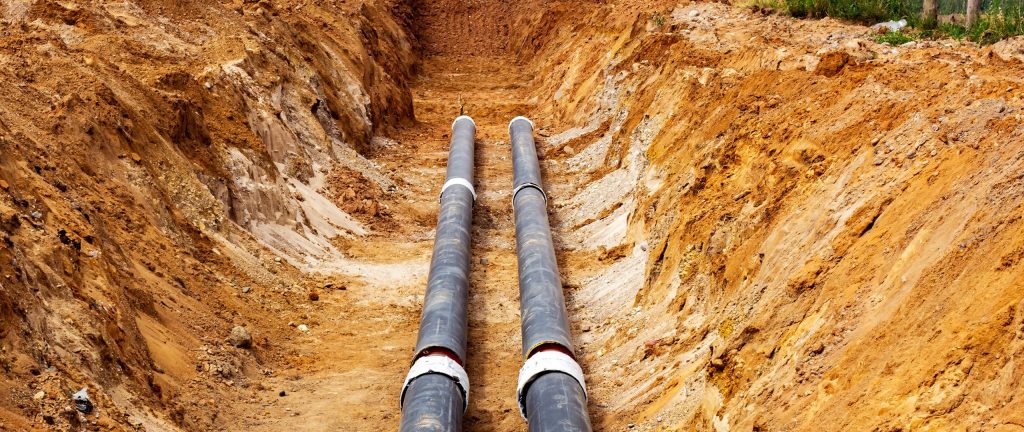
Buried plumbing systems operate out of sight but under constant stress. Whether serving potable water, sanitary sewer, or stormwater applications, underground pipes must resist soil loads, backfill pressure, settlement, surface traffic, buoyancy, and environmental exposure for decades. Sudden failures of such systems are rare. Instead, they develop slowly if bedding and backfill installation fall short of what the pipe material requires or site conditions shift during operation.
Trenching, Bedding, and Load Control
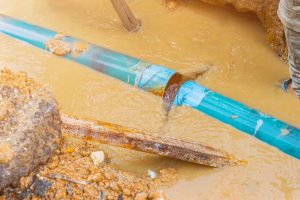 Plumbing codes require continuous, uniform support for buried pipe systems. The International Plumbing Code (IPC) and Uniform Plumbing Code (UPC) mandate solid trench bottoms, proper bedding, and protection from point loads. Codes also establish minimum burial depth to protect against surface loads and freeze conditions. For flexible pipes, standards such as ASTM D2321 emphasize that bedding and side support are structural elements, not optional details.
Codes and standards generally assume, however, that bedding, compaction, and embedment are executed correctly and remain stable over time. When those assumptions are not met, the pipe system may have to absorb unintended loads. For example, if bedding is uneven or poorly compacted, loads will get transferred unevenly along the pipe length and into joints. Over time, this can result in excessive deflection or joint separation, among other issues.
Material Behavior Underground
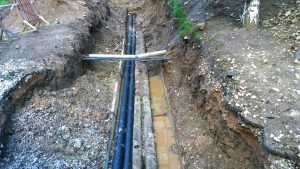 Multiple interacting risks influence long-term performance of buried pipe systems such as structural deformation under sustained loads, corrosion from aggressive soils or groundwater, buoyancy forces in high water tables or flood events, and permeation of external contaminants into and through pipe walls. How each pipe material responds to these conditions plays a central role in installation requirements and long-term durability.
- PVC and PE – Buried thermoplastic pipes have a degree of flexibility and are engineered to use soil for support. Without adequate bedding and side support, excessive deflection (often defined as more than 5% of pipe diameter) can lead to structural failure. Small installation errors can therefore have outsized consequences. In other words, plastic systems strongly link performance risk to installation quality, which can vary widely in the field. Thermoplastics offer good resistance to corrosion from many soil environments, which is one reason they are widely used underground. Certain plastics are susceptible to permeation, however, allowing hydrocarbons or other organic chemicals in contaminated soils to migrate through the pipe wall and compromise water quality. In addition, the relatively low density of plastic pipes can create buoyancy risks in high groundwater or flood conditions, increasing the likelihood of pipe movement, joint separation, or misalignment if either anchoring or cover are inadequate.
- Copper – Copper pipes are widely used for buried potable water service lines because of their dimensional stability and mechanical strength. Copper does not rely on soil deformation to carry load and is less prone to shape change under sustained pressure. Copper performs well in most soil conditions and that corrosion risks can be effectively managed through proper assessment of soil chemistry, use of protective sleeves where needed, and avoidance of dissimilar-metal contact. Copper is also not subject to permeation and does not present buoyancy concerns to the same degree as plastics.
- Cast Iron and Ductile Iron – For buried drain-waste-vent systems, iron pipes offer high crush strength, stiffness, and durability; resist deformation under soil and surface loads; maintain alignment; and are less dependent on compaction to perform as intended. While proper bedding is still required, the rigidity of cast iron and ductile iron reduces sensitivity to minor settlement and uneven backfill. Its mass also resists buoyancy forces in saturated soils.
- Steel – Buried steel pipes are designed to resist earth loads, live loads, and internal pressure, but require attention to trench geometry, bedding uniformity, and backfill compaction to prevent unintended stress concentrations. Buried steel pipes also require corrosion protection.
Designing for Durability
Buried pipe performance is a system outcome. Durability is achieved not by meeting minimum requirements alone, but by aligning material choice, installation practices, and exposure conditions. This requires a clear understanding of how loads, environmental conditions, and material characteristics interact. Flexible plastic pipes demand excellent soil support, compaction control, and attention to buoyancy and permeation risks, particularly in contaminated or high-groundwater sites. More rigid materials such as copper, cast iron, ductile iron, and steel can offer greater resistance to deformation and are less sensitive to installation variability, but still require thoughtful installation, corrosion protection where applicable, and coordination with site conditions.