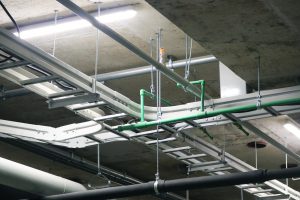
 Suspended plumbing systems operate under a simple but unforgiving force: gravity. Plumbing systems responsible for potable water distribution, drain-waste-vent functions, and fire-suppression are all subject to continuous load over their entire service lifetimes. When support systems are not designed and installed to manage that load appropriately, deflection, joint stress, and long-term failure can follow, even when a system may technically meet code requirements.
Support requirements for plumbing systems vary by function, but the underlying physics are the same.
- Potable water systems must limit deflection to avoid overstressing joints and fittings, particularly during pressure surges and thermal expansion.
- Drain-waste-vent systems are especially sensitive to sagging, which can alter slope, create ponding, and accelerate buildup and blockage.
- Fire-sprinkler systems must maintain alignment and integrity under both static loads and dynamic conditions, because support failures directly compromise life safety.
 Lessons from the Field
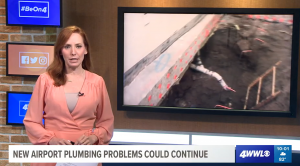
Widespread failures of suspended plastic sewer piping beneath Louis Armstrong New Orleans International Airport offer a cautionary example. Investigations found that installation contractors had reduced the number of hangers supporting the plastic pipes, despite inspectors warning them that the underlying soil was likely to settle. The support spacing met code requirements but was not robust enough for actual site conditions.
As soil beneath portions of the terminal settled, plastic pipes sagged between hangers in lateral lines, leading to deflection, joint separation, and more than 100 breaks. Crews had to cut large access holes in the finished terminal floor to make repairs, causing delays and extensive additional costs.
Material Behavior Drives Support Needs
Different pipe materials respond very differently to gravity and sustained loads:
- PVC, CPVC, and PEX pipes are less stiff. Under constant load, they can deflect and creep over time, increasing stress at joints. When installed with hanger spacing, alignment, and movement control that reflect their material behavior, they can perform as intended. In other words, plastic pipes can be supported safely but have a narrower margin for error under sustained gravity loads.
- Copper pipes provide moderate stiffness and typically require fewer supports than plastic but still demand careful spacing.
- Cast iron and steel pipes are the stiffest and heaviest. These qualities help maintain alignment over longer spans but their greater weight increases demands on hangers and structure.
To summarize, pipe materials with higher stiffness have some advantages. First, they require fewer hangers over a given distance, as noted in the table below, reducing costs of components and labor. Further their increased structural strength makes them less reliant on error-free installation to perform reliably over decades of service.
What Codes Say… And What They Don’t
The International Plumbing Code (IPC) and Uniform Plumbing Code (UPC) establish minimum hanger spacing for water and drain-waste-vent systems based on material and diameter. NFPA 13 governs support and bracing for fire-sprinkler piping, addressing both gravity loads and seismic forces. These codes provide a baseline, not a performance guarantee. They do not account for all real-world variables, including settlement, construction tolerances, vibration, extended pipe runs, or long-term material behavior under sustained load.
Designing Beyond Minimums
The sewer failures at New Orleans International Airport underscore an essential principle: supports are structural elements of plumbing systems, not accessories. Architects and engineers must evaluate whether minimum support spacing accounts for the specific pipe materials, the environment, and the risk profile of a given project. Resilient suspended plumbing systems are those that actively manage the stresses of gravity and operation – hanger by hanger, over decades of service – to ensure they will perform reliably.