
How Pipes Are (and Are Not) Regulated in the U.S.

Most architects, engineers, contractors, and building owners assume that if a product is approved by code and carries the required certifications, it has been thoroughly evaluated and can be considered functionally equivalent to competing products. In reality, the U.S. regulatory system is more nuanced, leaving gaps that can lead to unfortunate project outcomes in the medium and longer terms.

Building codes, plumbing codes, product standards, and certification programs play a critical role in protecting public health and safety. They have helped improve sanitation, reduce fire risks, improve drinking water quality, and establish minimum expectations for product performance. Yet these systems are not designed to identify the best product, the most durable product, or even necessarily the safest product available.

Rather, they are designed to establish a minimum threshold of acceptable performance while balancing public health objectives against economic feasibility, available technology, and practical implementation. As the International Code Council (ICC) explains, its model codes provide “minimum requirements to safeguard the public health, safety and general welfare.” Similarly, EPA drinking water standards are based not only on health considerations but also on what can be achieved using available technologies at reasonable cost.

This distinction is important because buildings should last for decades, and building plumbing systems are often expected to remain in service for 50, 75, or even 100 years. Yet many regulatory decisions are based on laboratory testing, limited-duration studies, and performance criteria that do not fully capture long-term risks, cumulative exposures, maintenance burdens, or lifecycle impacts.

Understanding what regulators consider, and what they don’t, is therefore essential for anyone involved in the design, construction, ownership, or operation of buildings.
Key Considerations that Shape Building Codes & Standards

The U.S. regulatory system primarily considers public health and safety, technical feasibility, economic feasibility, laboratory testing, and stakeholder input.

  • Health and Safety: The primary purpose of building and plumbing codes is to protect public health, safety, and welfare. Regulators seek to reduce risks associated with contamination, fire, structural failure, sanitation problems, and other hazards.
    Importantly, however, regulatory systems rarely seek to eliminate all risk. Instead, they generally attempt to reduce risks to levels deemed acceptable based on available evidence and practical constraints.
  • Technical Feasibility: Regulators must consider whether compliance can realistically be achieved using available technologies. EPA states that “The legal limit for a contaminant reflects the level that protects human health and that water systems can achieve using the best available technology.” In other words, regulations are often shaped not only by what is safest, but by what is technically achievable at scale.
  • Economic Feasibility: Cost is another significant factor. Federal agencies, code bodies, and standards organizations frequently evaluate affordability, implementation costs, and economic impacts when developing regulations and standards. This balancing process can create tension between maximizing public health protection and minimizing economic burdens. 
  • Laboratory Testing and Standards Compliance: Many building products are approved through compliance with consensus standards developed by organizations such as ASTM, NSF, UL, ASME, and others. For potable water distribution, NSF/ANSI/CAN 61 serves a primary framework for evaluating chemical leaching from pipes, fittings, valves, and other components. Most jurisdictions rely heavily on these certifications rather than conducting independent testing.
  • Industry Participation: Industry representatives play a significant role in standards development and code processes. Supporters argue that manufacturers contribute valuable technical expertise and practical knowledge. Critics counter that allowing manufacturers to help shape the requirements governing their own products can create potential conflicts of interest and influence outcomes in ways that favor market adoption over precaution. These competing perspectives illustrate one of the central tensions within the regulatory system: balancing expertise, innovation, and economic growth against independent oversight and public protection.

Gaps in Codes & Standards

While the system evaluates many important factors, there are also notable areas that are not covered and issues that may not be fully considered.

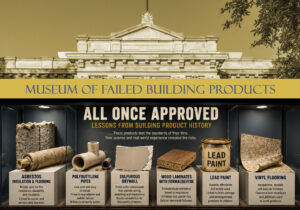
History offers many examples of building products that were code-compliant and considered safe, only to reveal significant safety and/or performance problems. This museum (or hall of shame) includes the following:

Lead Paint & Pipes: Lead-based paint and plumbing components were widely used despite growing evidence of health risks. Today, lead exposure is recognized as a major cause of neurological and developmental damage.

Polybutylene Pipes: From the 1970s to mid-1990s, polybutylene was hailed as a low-cost alternative to copper pipes. Over time, exposure to chlorine and other disinfectants contributed to unexpected failures and extensive leaks.

Vinyl Flooring: So-called luxury vinyl flooring gained adoption because it was cheap and versatile. Concerns are emerging about phthalate plasticizers and other chemicals associated with health and environmental impacts of vinyl production.

Sulfurous Drywall: Imported drywall used extensively during the mid-2000s was later found to emit sulfur compounds that corroded wiring, plumbing components, HVAC equipment, and electronics, resulting in thousands of costly remediation projects.

Asbestos Insulation & Flooring: For decades, asbestos was considered a miracle material because of its fire resistance, durability, and affordability. It was widely used in pipe insulation, floor tiles, and roofing. Asbestos was later linked to lung cancer, mesothelioma, and other serious diseases.

Formaldehyde-Containing Wood Laminates: Engineered flooring and cabinets often used formaldehyde-based adhesives. Research linked elevated indoor concentrations to respiratory irritation and increased cancer risk.

The Common Lesson: None of these products were introduced with the expectation they would cause problems, and most complied with applicable standards at the time. They demonstrate an important reality:
                 Code compliance is no guarantee of safety or durability.

  • Long-Term Performance in Operational Buildings: One of the most significant limitations is the lack of long-term field-performance data available when products are approved. Laboratory testing may demonstrate that a product meets a standard over weeks, months, or a few years. Building owners, however, may expect plumbing systems to perform reliably for generations. As a result, products can achieve code acceptance long before decades of real-world performance data become available.
  • Chemical Mixtures and Cumulative Exposures: U.S. regulatory frameworks generally evaluate chemicals individually rather than as complex mixtures. ProPublica observed that “the flaws in the American chemical regulatory apparatus run deep,” noting that the United States continues to evaluate and regulate chemicals largely on a substance-by-substance basis. Habitable has similarly argued that regulating chemicals individually often leads to “regrettable substitutions,” in which one problematic chemical is replaced with another that presents similar concerns.
  • Lifecycle Impacts: Traditional building and plumbing codes focus primarily on product performance during occupancy. They typically do not fully evaluate impacts associated with:
    • Raw material extraction
    • Manufacturing emissions
    • Worker exposure
    • Transportation
    • End-of-life disposal
    • Recycling challenges

As Habitable notes, “Toxic chemicals have a huge and complex impact on the health and well-being of people and the environment. Those impacts are spread throughout a product’s life cycle.”

  • Climate-Related Risks: Climate considerations are increasingly recognized by sustainability organizations but remain only partially integrated into most building product approval systems. Habitable notes that “Climate change is also altering how toxic chemicals impact our health and the health of the environment.” These interactions may affect chemical releases, environmental exposures, disaster resilience, and long-term building performance in ways that traditional standards were not designed to evaluate.
  • The Growing Scale of Plastic Building Materials: The magnitude of modern material choices also receives limited attention in most code discussions. According to Habitable, “Building and construction is the second highest-use sector for plastics behind packaging, accounting for 17% of total plastic production.” Yet most product approvals evaluate individual products rather than broader cumulative impacts across entire building sectors.
  • Independence of Certification Systems: Many product approvals depend heavily on third-party certification organizations. While these organizations provide important services, critics have raised concerns regarding transparency, governance, and potential conflicts of interest. Jennifer Clancy, Executive Director of the Environmental Science & Policy Institute, wrote that a controversial NSF partnership broke with “NSF’s commitment to independence and its role as an honest broker to all stakeholders.” Whether or not one agrees with this criticism, the appearance of a conflict of interest highlights ongoing debates about how independent certification systems should be governed and overseen.

Implications for Industry Professionals, Owners & Building Occupants

Taken together, these limitations reveal an important reality: regulatory approval is not synonymous with comprehensive evaluation. Architects, engineers, and contractors should recognize that code compliance represents a minimum threshold, not necessarily an optimal solution. A pipe material may satisfy applicable codes while still raising legitimate questions regarding:

  • Long-term durability
  • Maintenance requirements
  • Fire performance
  • Chemical exposure
  • Repairability
  • Resilience
  • Lifecycle cost

Rather than relying solely on code approval, design teams have a responsibility to evaluate available research, field experience, warranty history, service-life expectations, and emerging evidence.

Building owners who assume approved products have been comprehensively vetted for all relevant risks may discover this is not the case. In reality, approvals often reflect a balance between safety, cost, technology, and practical implementation rather than a determination that a product is the best available option. If they want plumbing systems to last decades, they need to carefully consider durability, replacement costs, maintenance requirements, and historical performance in addition to code compliance.

Building occupants benefit greatly from modern codes and regulations. Compared with previous generations, buildings are generally safer, healthier, and more reliable. However, occupants should understand that regulation is often reactive rather than proactive. History shows that substances such as asbestos, lead, PFAS, and perchlorate remained in widespread use long after concerns were first raised. Regulatory systems typically require substantial evidence before action occurs, meaning potential hazards may persist for years before being fully addressed.

Recommendations

The U.S. building-product regulatory system has produced substantial public-health benefits and remains an essential safeguard for society. Yet it is important to understand what the system is designed to accomplish—and what it is not. Codes, standards, and certifications establish minimum acceptable requirements. They are not intended to identify the most durable, healthiest, safest, or most sustainable product in every application. Nor do they guarantee superior long-term performance.

For architects, engineers, and contractors, this reality creates an obligation to look beyond compliance. Material selection decisions should incorporate factors that codes may not fully address, including durability, proven field performance, service life, maintenance requirements, occupant health, environmental impacts, and resilience.

The assumption that all code-approved products are essentially equivalent can lead to poor long-term outcomes – and liability if inferior products fail. Buildings often outlast the assumptions embedded in the standards used to approve their materials. As a result, design professionals should view code compliance not as the finish line, but as the starting point for thoughtful material evaluation.