 This article summarizes research by Clemson’s Seyed M. Yadollahi and Kalyan R. Piratla, whose work presents a comprehensive review of deterioration mechanisms affecting plastic piping used for building plumbing applications. The authors note that while plastic pipes are commonly assumed to deliver long service lives, “there have been many seemingly premature failures warranting a comprehensive understanding of their failure mechanisms.” These incidents rarely stem from a single issue but instead result from interacting risks linked to “various material, design, installation, operational, and maintenance-related factors” that lead to premature failure.
From a professional-practice perspective, this research highlights the importance of carefully considering failure risks when selecting materials. Neglecting to do may expose architecture, engineering, and construction teams to liability exposure and forensic scrutiny following damage to a building and negative impacts on occupants.
Yadollahi and Piratla found that pipe failures often start at high-stress points created at any stage in the product lifecycle.
- Manufacturing-related risks: Faults or variations in production may lead to pipe porosity, inclusions, or high crystallinity, among others.
- Installation-related risks: Gouging of pipe walls, UV exposure during storage, improper support of suspended or underground pipes, poor joint work can create weaknesses.
- Service-related risks: Ongoing stresses from thermal expansion, exposure to adverse chemicals or construction materials, and accidental impacts, in addition to operational wear.
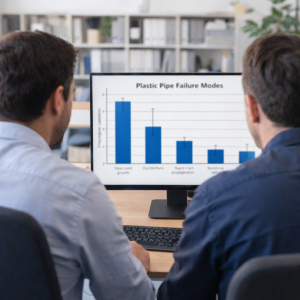
Once high-stress points appear in a plastic pipe, crazing and cracking become dominant deterioration pathways. Over time, these cracks may evolve into ductile rupture, slow crack growth, or, in rarer cases, rapid crack propagation. Slow crack growth is particularly concerning because it occurs “under stresses below the yield point” and can progress without visible deformation, resulting in sudden leakage or rupture.
Environmental exposure may significantly accelerate deterioration mechanisms. A wide range of chemicals can deplete antioxidants and embrittle polymers, and interactions between such chemical degradation and mechanical stress are defining features of environmental stress cracking.
In addition to cracking, buckling and deformation pose structural risks due to plastic pipe’s relatively low stiffness. While buckling may not immediately cause leakage, “it contributes to other failure mechanisms causing leakage” by increasing localized wall stresses.
For architects and engineers, the takeaways are clear: interacting risks in plumbing systems elevate performance concerns. As explained in this overview of liability issues related to pipes, material weaknesses may also escalate professional liability, due to expanding legal responsibility for design professionals due and subrogation claims from insurance carriers when failures occur.